Diller + Scofidio
Blur Building
2002
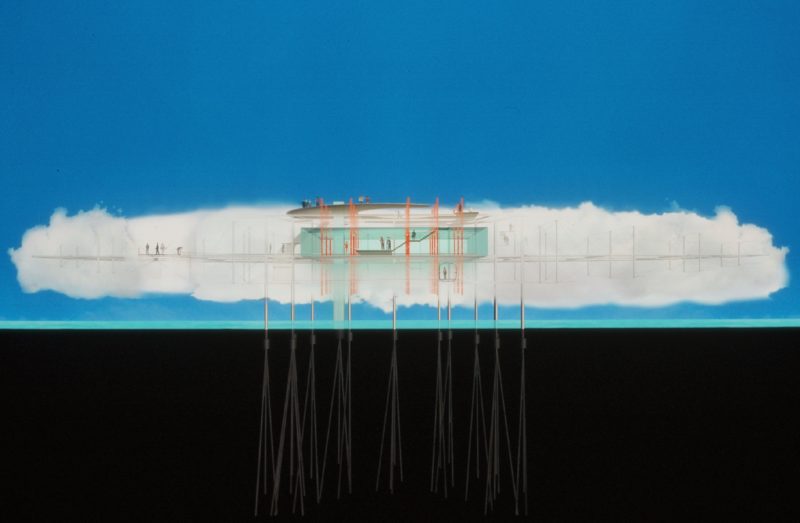
Diller + Scofidio’s Blur Building (2002) erased the boundaries of architecture by making a structure out of weather. Built for the Swiss Expo on Lake Neuchâtel, the pavilion used 31,500 high-pressure nozzles to spray a fine mist of water, creating a massive cloud suspended over a floating platform. Visitors approached by ramp and disappeared into the fog, immersed in an environment without edges, walls, or objects.
Scale became unstable. From afar, the pavilion read as a glowing cloud hovering over water; from within, the mist dissolved depth and orientation. The building existed not as mass but as atmosphere, a condition more than a form.
Representation was inverted. Rather than depicting solidity, the Blur Building staged its absence. Architecture was stripped down to light, moisture, and perception — an environment in constant flux. Visitors did not see the building; they experienced it.
Materiality was elemental: water, air, and light were the building blocks. The technology behind it remained hidden, allowing nature itself to appear as architecture.
In the context of a total work of art, the Blur Building is exemplary. It unified technology, environment, and human presence into one seamless field. Nothing felt separate or ornamental; every misted particle contributed to the whole. The pavilion transformed architecture from object into climate, proving that design can be less about what we build and more about the atmospheres we create.
Architecture, Atmosphere, Scale, Perception, Representation, Ambiguity