Hussein Chalayan
Table Dress
2000
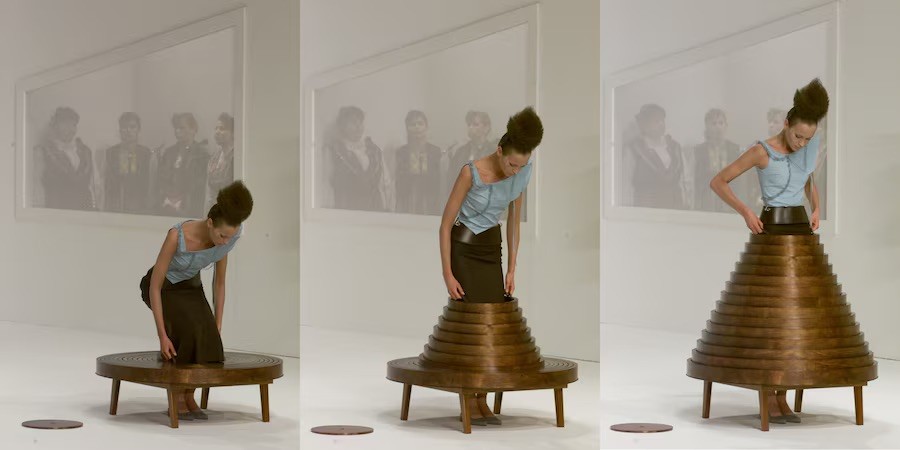
Hussein Chalayan’s Table Dress (2000) is one of the most iconic examples of fashion crossing into architecture. Presented during his Autumn/Winter 2000 show, the piece began as a wooden table placed on stage. As the performance unfolded, the tabletop was lifted and unfolded into a skirt, worn by a model who walked the runway with the object as garment.
Scale is inverted. A piece of furniture, designed for collective use, becomes intimate clothing. The domestic is re-framed as fashion, collapsing the categories of object, interior, and body.
Representation is performative. The act of transformation — table becoming skirt — is the work itself. Rather than simply showing a garment, Chalayan stages design as event, making the runway a space where architecture, product, and fashion are indistinguishable.
Materiality adds to the provocation. Wood and metal, typically rigid and functional, are reconfigured as couture. The heaviness of furniture collides with the ephemerality of fashion, producing a charged ambiguity.
The brilliance of the Table Dress lies in its totality. Every element — object, body, stage, gesture — belongs to the same system. It does not just display clothing; it demonstrates how design can move across disciplines without losing coherence.
In this work, Chalayan achieves the essence of a total work of art: a piece that is not simply worn but staged, not just fashion but environment. It reminds us that even the most ordinary objects can be transformed into language when framed through design.
Fashion, Architecture, Transformation, Scale, Representation, Ambiguity Content: