Monika Sosnowska
Facade
2013
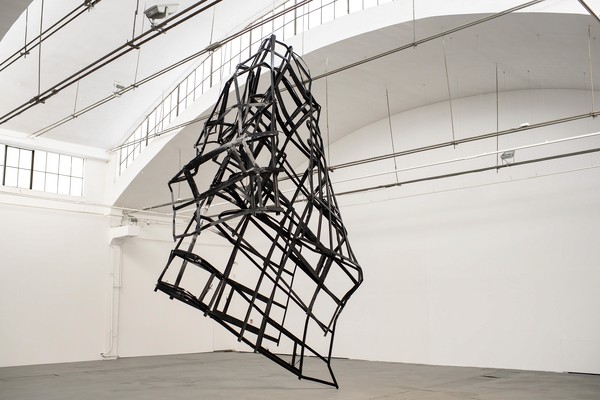
Monika Sosnowska’s Facade (2013) presents a fragment of modernist architecture twisted, crumpled, and forced into an exhibition space. What should have been rigid steel structure is instead folded like cloth, a collapse that destabilizes the very language of architecture.
Scale becomes unstable: the work is monumental in presence yet distorted into an object that resists function. What was once infrastructure is now sculpture; what was once building is now artifact. In this inversion, Sosnowska reminds us that architecture’s authority is not fixed—it can be bent, broken, and reimagined.
Representation in Facade is double-edged. It references modernist ideals of permanence and order, yet its very form undermines those promises. Ambiguity thrives: is this ruin, relic, or resistance? Materiality is central—the heavy steel, impossibly warped, reads as fragile as paper, flipping our assumptions about strength.
Within a Gesamtkunstwerk frame, Sosnowska’s work operates as critique and reconstruction. She collapses the distinction between object and environment, architecture and sculpture. Facade does not simply represent a building—it re-stages the very act of architecture as mutable, poetic language.
Sculpture, Architecture, Scale, Materiality, Collapse, Ambiguity