Jesse Reiser & Nanako Umemoto
Aktion Poliphile: Hypnerotomachia Hypniahouse
1989
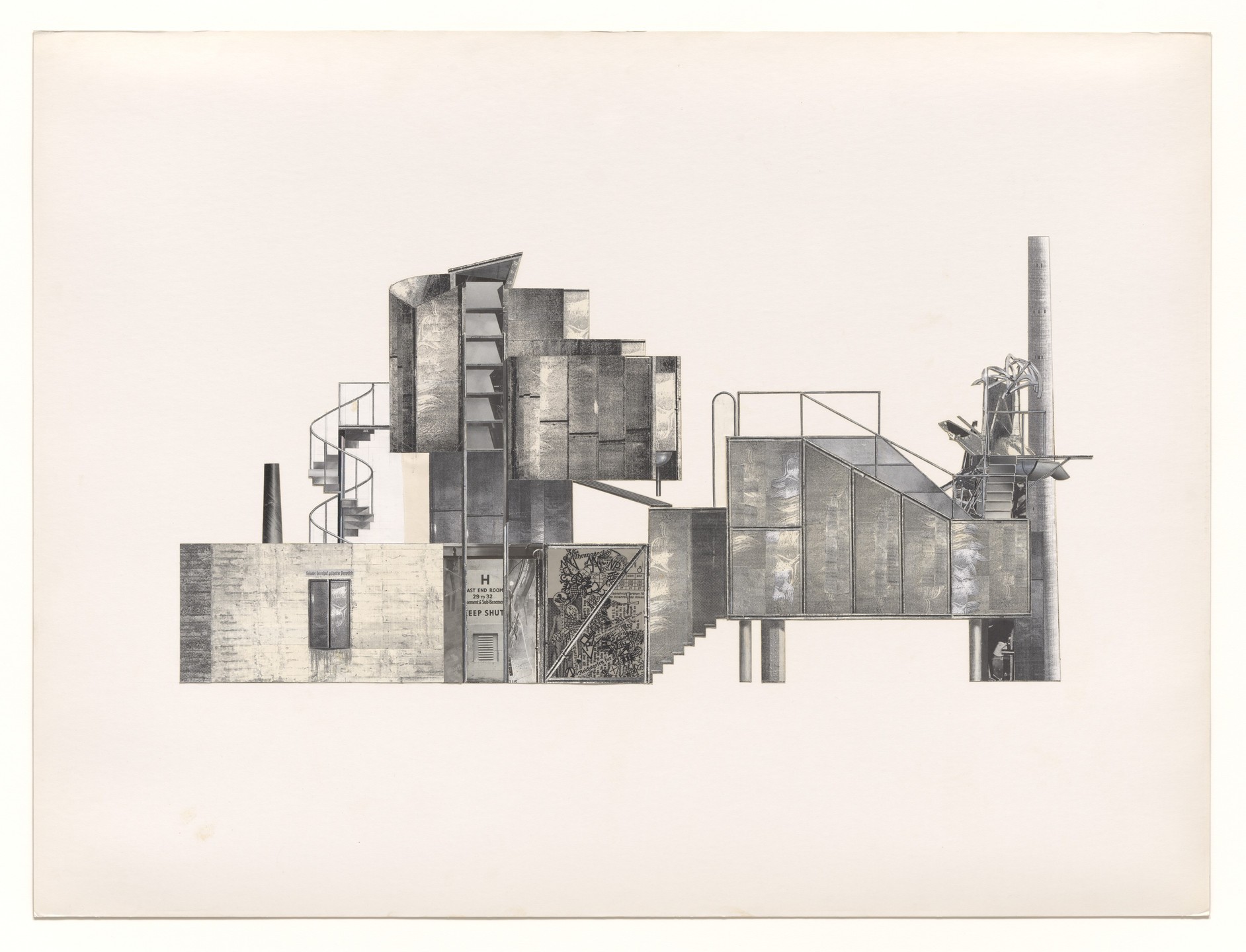
Reiser + Umemoto’s Aktion Poliphile (1989) is a proposal for a family house in Wiesbaden, but its form refuses the conventions of domestic space. Built through collage—electrostatic prints, halftone lithographs, polymer sheets, gouache, and graphite—the work operates less as blueprint than as narrative construction.
Its title references the Renaissance text Hypnerotomachia Poliphili (1499), where dreamlike sequences merge architecture, garden follies, and landscapes into allegory. Likewise, Reiser + Umemoto treat architecture as an oneiric field: a spiral staircase leads to a bridge that connects nowhere, elements are layered irrationally, domestic space becomes uncanny.
Scale is destabilized: details behave as monumental gestures, while architectural volumes collapse into ornamental fragments. Representation here is not descriptive but performative—cutting, pasting, and hybridizing to generate new architectural realities.
In the context of Gesamtkunstwerk, Aktion Poliphile embodies a total work not through built form, but through layered imagination. It unifies literature, architecture, image, and narrative into a single visual language. Ambiguity is the point: the house is at once proposal and fiction, plan and dream.
The project insists that architecture can exist fully in representation—that collage itself is a mode of constructing worlds.
Architecture, Collage, Representation, Ambiguity, Hybrid